How to Turn Missed Practice Questions Into an Error Log With ChatGPT
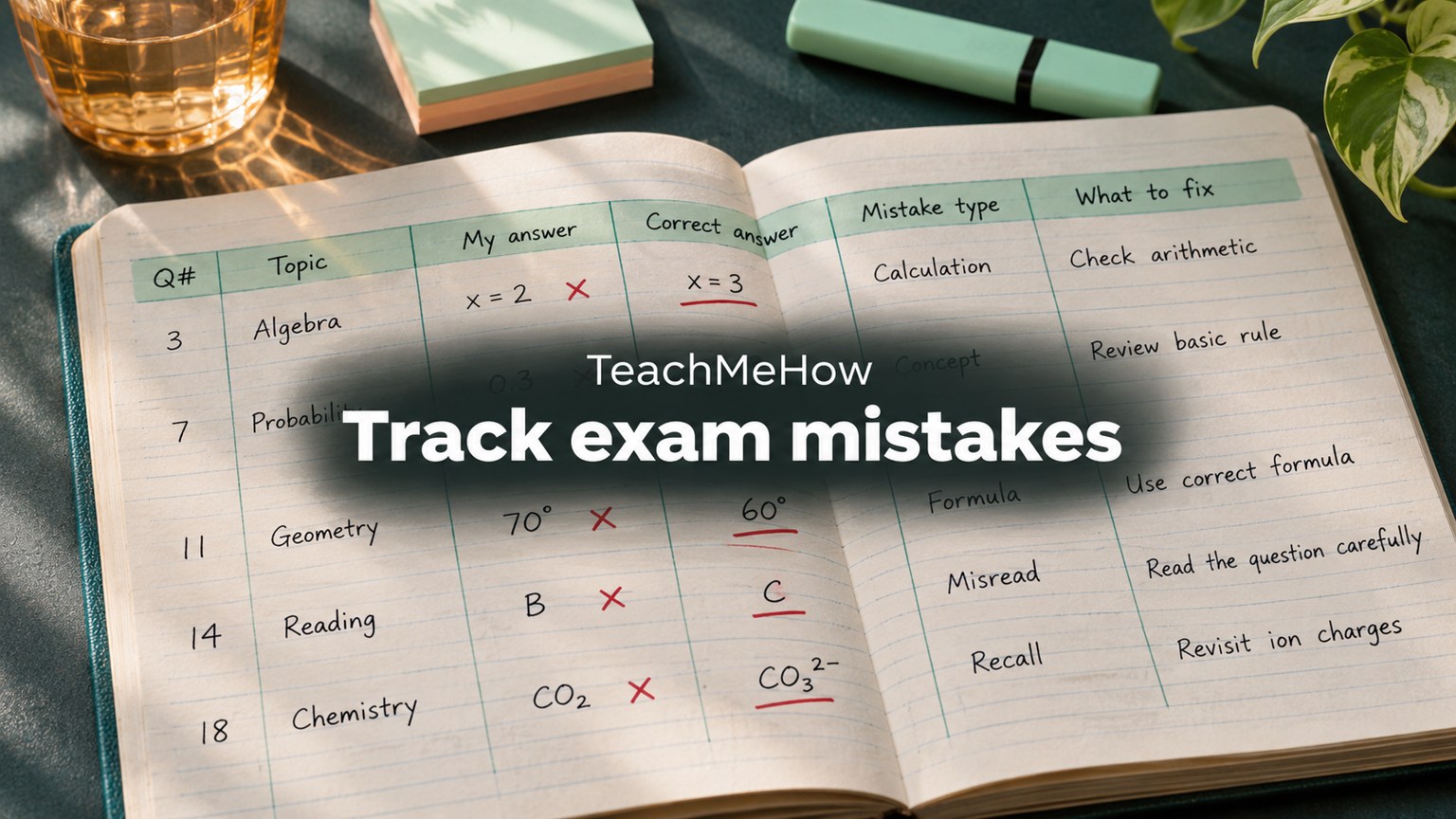
Record why each answer went wrong, choose a specific correction, and use a fresh question to see whether the same mistake returns.
Follow these steps at your own pace. Check product terms and prices directly with providers before purchasing.
Quick answerGive ChatGPT the practice question, your original reasoning and a trusted correction. Ask it to identify the first observable error and suggest a fresh question that would expose the same mistake. Keep the log entry open until you can answer that new question unaided.
Save the attempt before reading the solution
After a practice test, it is tempting to erase the wrong answer or replace it with a clean solution. Keep both. A final answer of “8” could come from a calculation slip, the wrong formula or guessing under time pressure. The written work, your confidence at the time and whether you reached the item before the timer ended make those explanations easier to distinguish.
Start with three questions. Label them by practice set and item, and include only material you are allowed to share. Copy each prompt or a faithful summary, your answer, the verified key and any instructor feedback. If the key is disputed, label it unresolved first. An uncertain key is a poor foundation for a diagnosis.
Ask for evidence and permit an unknown cause
For each item, compare my attempt with the verified correction. Quote the earliest step you can identify as wrong, propose a specific cause only when the work supports it, and ask one clarifying question if it does not. Give a correction I can perform, a new practice item for the same skill and a criterion for closing the entry. Keep unfinished items separate.
Use categories small enough to change what you do next: misread the unit, selected the wrong procedure, skipped a condition, made an arithmetic error or ran out of time. “Careless” gives you little to practice. A correct guess deserves a row when you cannot explain the method. A blank may simply mean the question came after the timer rang.
See how one row can change your next attempt
Suppose a practice question asks for the mean of 4, 6, 8 and 10. Your working says 28 ÷ 3. You correctly added four observations and then divided by three. The visible mistake is the divisor. If you say you counted the gaps between the numbers, the corrective action is to count the observations before dividing. Without that explanation, record the divisor error and leave the cause uncertain.
| Record field | Example entry |
|---|---|
| Evidence | Set A, Q3. My line was 28 ÷ 3. |
| Correction | Count the four observations before choosing the divisor. Correct mean is 7. |
| Fresh retry | Find the mean of 2, 5, 8, 9 and 11. Write the count first. |
| Closure check | Five observations, sum 35, mean 7. Show all three independently. |
The two examples deliberately share the answer 7. Remembering that number cannot close the entry. Hide the check and write the divisor and sum. For a stronger second retry, change 11 to 16. The sum becomes 40 and the new mean is 8. This catches a student who has learned to repeat the earlier answer.
Separate the repair from the retest
Have ChatGPT show you the correction today and keep the fresh problem somewhere you can open later without seeing the answer. Use a notebook or spreadsheet with columns for question, evidence, repair, retry date and result. A next-day retry is one practical starting point. If the test is tomorrow, use a later session on the same day and keep the time constraint realistic.
If several entries involve algebra, check the first invalid line in each solution before grouping them together. If most blanks occur at the end of a set, run a shorter timed section to distinguish a pacing issue from missing content. Adjust your five-day study schedule using the pattern you actually observed.
Know when a row is finished
Mark an entry resolved only when you can explain the correction and apply it to a new question under the relevant conditions. Keep the unsuccessful attempt beside the later success so you can see what changed. Carnegie Mellon’s exam reflection examples suggest additional ways to review patterns after a test.
Comments
Comments are reviewed before they become public.
Sign in with Google to leave a comment.
Sign in with GoogleNo approved comments yet. Be the first to start the discussion.