Compare grating faces, base stability, and catch containers for shredding cheddar, grating hard cheese, and prepping vegetables.
Quick AnswerStart with a stable base, a comfortable top handle, and the two faces you will actually use. Coarse holes are useful for cheddar and vegetables; finer teeth suit hard cheese. Choose a catch container if you frequently measure or store the shreds.
Compare Your Options
| Type | Best for | What to check |
|---|
| Classic four-sided grater | Everyday cheese and vegetables | Usable coarse face and room for your hand |
| Fine-toothed multi-face grater | Hard cheese and fine aromatics | Tooth pattern and access for rinsing |
| Grater with catch container | Measuring ingredients during prep | Container fit, markings, and lid |
1. Read the faces before counting them
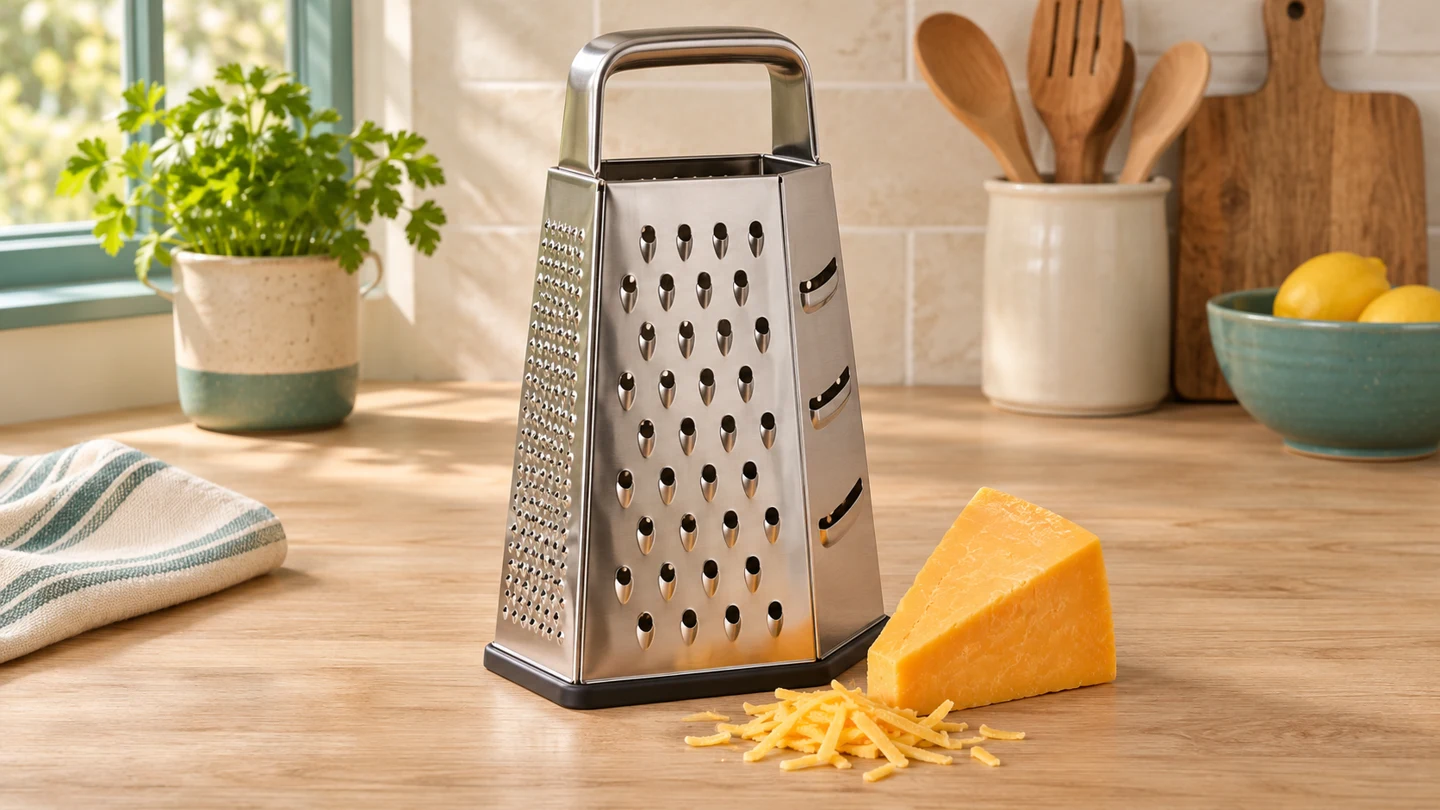
Look at a close-up of each side. Large holes produce substantial shreds for potatoes and cheddar. Smaller teeth give a finer texture for finishing pasta. A slicing slot does a different job entirely, so a four-sided grater may have only two faces you routinely want.
2. Compare stability with your usual work surface
The whole base should sit flat on your board or plate. A wide base and non-slip rim can steady longer downward strokes. A narrow grater takes less cupboard space, but check that your hand fits the top handle and that the grating face is wide enough for your usual block of cheese.
3. Decide where the shreds should land
For salads, it can be easiest to grate directly on a board and lift the frame away. For a casserole, a container underneath keeps multiple portions together. Check whether the container attaches firmly and whether it can be removed without scattering shreds.
Buying tipLook through the open bottom in the product photos. If your brush cannot reach behind the finest face, sticky cheese or ginger will be harder to remove.
What to Choose for Your Kitchen
| When you’re cooking | Look for |
|---|
| Grating potatoes for a skillet | A tall, coarse face and a stable base |
| Finishing pasta at the table | Fine teeth for a light layer of cheese |
| Prepping measured cheese in advance | A fitted catch container with a lid |
Common Mistakes
- Assuming each side produces a different useful shred.
- Ignoring the height of the handle when measuring a cabinet.
- Choosing an opaque catch box without checking how to judge the fill level.
Before You Buy: A Quick Checklist
- The coarse and fine faces match my recipes.
- The base fits my board or plate.
- I can empty and clean the inside comfortably.
Bottom Line
Pick by the texture you need and how the grater sits on your board. A catch container is worth the space when it removes a measuring or storage step from your usual recipe.


Comments
Comments are reviewed before they become public.
Sign in with Google to leave a comment.
Sign in with GoogleNo approved comments yet. Be the first to start the discussion.